
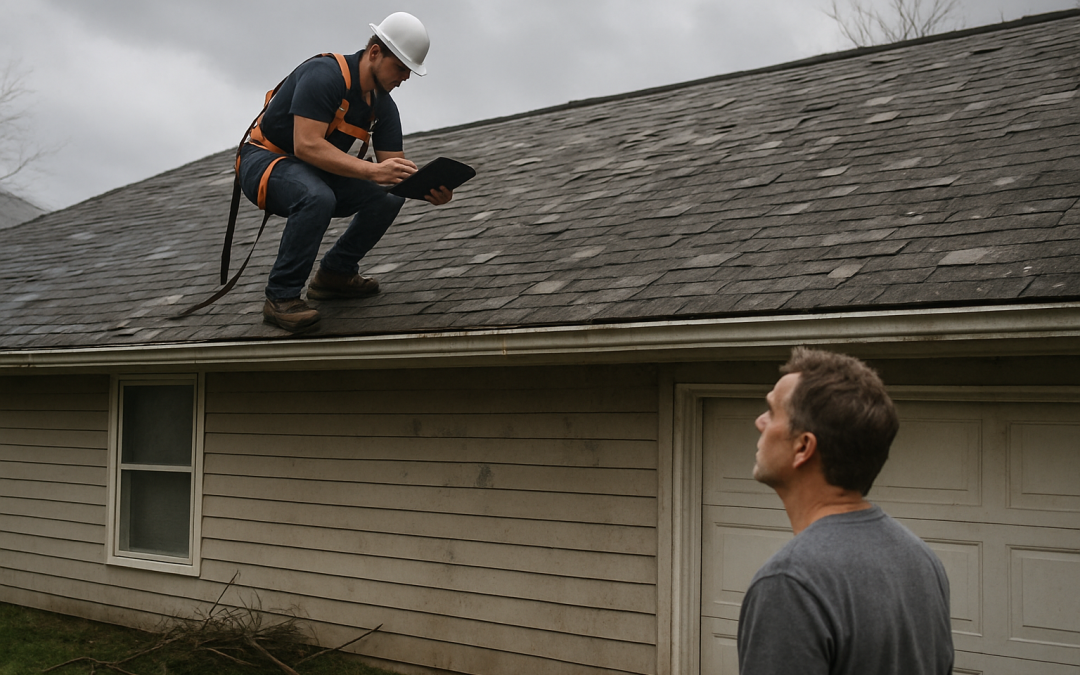
Roof insurance claims are approved or denied based on what caused the damage, how old your roof is, and what your specific policy covers. In most cases, sudden storm damage (like hail or wind) is covered, while wear and tear or an old roof usually is not. If your claim is approved, the payout is based on your policy type (Actual Cash Value or Replacement Cost), your deductible, and the adjuster’s inspection. Every claim is different, so even similar damage can lead to different outcomes depending on your coverage and roof condition.
If you’re dealing with roof damage, insurance questions, or a possible replacement, this guide walks you through how roof insurance claims really work. It’s written for homeowners who don’t speak “roofing” and need clear answers about coverage, costs, and what to do next.
Table of Contents
- How Roof Insurance Claims Work in Plain Language
- What Roof Damage Insurance Typically Covers
- What Roof Damage Insurance Often Denies
- Common Causes of Roof Damage and How Insurance Sees Them
- What to Check First (Safe, From the Ground)
- Signs the Roof Problem Is Serious
- How Insurers Decide If a Roof Claim Gets Approved
- How Roof Insurance Payout Decisions Are Actually Made
- Roof Repair vs Replacement Costs
- When to File a Roof Insurance Claim (and When Not To)
- Repair vs Replace: How to Decide
- Timeline and How Fast You Need to Act
- Common Homeowner Mistakes With Roof Insurance Claims
- Frequently Asked Questions
- Summary and Next Steps
How Roof Insurance Claims Work in Plain Language
Homeowners insurance is designed to cover sudden, accidental damage to your roof, not slow wear and tear. When you file a claim, the insurance company sends an adjuster to inspect the roof, decide if the damage is covered, and estimate the cost to repair or replace it.
From there, the insurer compares the estimate to your policy rules and your deductible to decide how much they’ll pay. The process is part inspection, part paperwork, and part negotiation between the adjuster, your contractor, and you.
Basic steps in a roof insurance claim
- Damage happens (usually from a storm, tree, or sudden event).
- You document the damage and contact your insurance company.
- An adjuster inspects the roof and reviews your policy.
- The insurer decides if the claim is covered and how much they’ll pay.
- You hire a roofing contractor to do the work, often using the insurance estimate as a starting point.
What Roof Damage Insurance Typically Covers
Most standard homeowners policies cover roof damage caused by “sudden and accidental” events. The exact wording varies, but these are usually considered covered causes, assuming your roof isn’t already in bad shape:
Common covered events
- Wind damage – missing shingles, lifted shingles, or torn-off sections after strong winds.
- Hail damage – bruised, cracked, or broken shingles from hailstorms.
- Falling objects – tree limbs or debris that hit and damage the roof.
- Fire – roof damage from house fires or nearby fires.
- Some water damage – interior damage caused by a covered roof leak (for example, wind-driven rain after shingles blow off).
Coverage is always tied to the cause. The same leak might be covered if it came from storm damage, but denied if it’s from an old, worn-out roof.
What Roof Damage Insurance Often Denies
Insurance companies are quick to deny claims that look like maintenance issues or age-related problems. They expect homeowners to maintain their roofs and replace them when they’re at the end of their lifespan.
Common reasons roof claims are denied
- Old age and wear – brittle, curling, or cracked shingles with no clear storm event.
- Neglect – long-term leaks, rotted decking, or obvious lack of maintenance.
- Improper installation – shortcuts taken by a previous roofer or DIY work.
- Cosmetic-only damage – hail marks that don’t affect performance, depending on your policy.
- Excluded causes – certain types of water damage, mold, or specific perils your policy doesn’t cover.
Many denials are tied to roof age. For more detail on how age affects coverage, see the guide on why insurance claims get denied for roof age.
Common Causes of Roof Damage and How Insurance Sees Them
Storm damage (wind, hail, heavy rain)
Storms are the most common reason for roof insurance claims. Insurers usually cover storm damage if:
- The storm date can be tied to the damage.
- The roof was in reasonably good condition before the storm.
- The damage is more than just minor cosmetic wear.
Falling trees or branches
If a tree or large branch hits your roof and causes damage, that’s typically covered. Coverage can include:
- Roof repairs or replacement.
- Interior damage from resulting leaks.
- Sometimes tree removal, depending on your policy.
Age and wear
Roofs naturally wear out over time. When shingles reach the end of their lifespan, they crack, curl, and lose granules. Insurance usually considers this normal wear and tear, which is not covered.
Once your roof hits a certain age, some insurers reduce coverage or switch to paying only Actual Cash Value. For more on this, see how old a roof can be before insurance says it’s too old.
What to Check First (Safe, From the Ground)
You don’t need to (and shouldn’t) climb on your roof to understand if you might have a claim. You can do a basic check safely from the ground and inside your home.
Safe exterior checks
- Walk around your home and look for:
- Missing or obviously broken shingles.
- Shingles that look lifted or out of place.
- Pieces of shingles or roofing material on the ground.
- Dented gutters, downspouts, or metal trim (often a sign of hail).
- Check for tree limbs resting on or pressing into the roof.
Safe interior checks
- Look at ceilings and upper walls for:
- Water stains or brown rings.
- Bubbling or peeling paint.
- New damp spots after rain.
- If safe, peek into the attic with a flashlight:
- Look for wet insulation, damp wood, or visible daylight through the roof deck.
If you see active leaks, spreading stains, or obvious damage, it’s time to call a roofing contractor and possibly your insurance company.
Signs the Roof Problem Is Serious
Some roof issues can wait a bit; others need fast attention. These signs usually mean the problem is serious and potentially claim-worthy.
Urgent warning signs
- Water actively dripping from the ceiling or light fixtures.
- Large or quickly growing ceiling stains after a storm.
- Sections of missing shingles you can see from the ground.
- Visible sagging in the roof line or ceiling.
- A tree or large branch resting on or puncturing the roof.
Serious but less obvious signs
- Musty smells in the attic or upper rooms after rain.
- Repeated “small” leaks in the same area.
- Granules from shingles collecting heavily in gutters or at downspouts.
Serious issues can lead to mold, structural damage, and much higher repair costs if ignored. Insurance companies also expect you to prevent further damage once you know there’s a problem.
How Insurers Decide If a Roof Claim Gets Approved
Insurance companies follow a fairly standard process to decide whether to approve or deny a roof claim. Understanding this helps you know what to expect and what evidence matters.
Key factors insurers look at
- Cause of damage – Was it a covered event (storm, falling object, fire) or just age and wear?
- Roof age and condition – Was the roof near the end of its life before the damage?
- Policy language – Does your policy include or exclude certain types of roof damage?
- Maintenance history – Are there signs of long-term neglect or unresolved leaks?
- Documentation – Photos, contractor reports, and weather data that support your claim.
The adjuster’s role
The adjuster is the insurance company’s representative who inspects your roof. They will:
- Look for physical signs of storm damage versus wear and tear.
- Measure the roof and affected areas.
- Take photos and notes for the claim file.
- Prepare an estimate of what it should cost to repair or replace the damaged sections.
Their report heavily influences whether your claim is approved and how much is paid. Having a reputable roofing contractor present during the inspection can help ensure damage is properly documented.
How Roof Insurance Payout Decisions Are Actually Made
Once the adjuster’s report is complete, the insurance company calculates your payout based on your policy type, your deductible, and the scope of damage.
ACV vs RCV: how it changes your payout
- Actual Cash Value (ACV) – Pays the depreciated value of your roof. Older roofs get smaller payouts because the insurer subtracts for age and wear.
- Replacement Cost Value (RCV) – Pays what it actually costs to replace the damaged roof with similar materials, minus your deductible. Often paid in two parts: initial payment and a second payment after work is completed.
To understand these payout types in more detail, see the guide on ACV vs. RCV roof insurance.
How the numbers usually work
- The adjuster estimates the total cost to repair or replace the damaged area.
- The insurer applies depreciation if your policy is ACV or if your roof is very old.
- Your deductible is subtracted from the approved amount.
- The remaining amount is what the insurer offers to pay, often in one or two payments.
For example, if a full replacement is estimated at $12,000, your deductible is $2,000, and depreciation is $3,000, your initial payout might be $7,000, with some or all of the $3,000 depreciation paid later if you complete the work (under RCV).
Roof Repair vs Replacement Costs
Understanding rough cost ranges helps you decide whether a claim is worth filing and whether repair or replacement makes more sense.
Typical cost ranges
- Minor roof repair: $150–$1,000
- Small patching, a few shingles replaced, minor flashing fixes.
- Moderate repair: $1,000–$3,000
- Larger leak areas, multiple sections of shingles, some decking repair.
- Major repair: $3,000–$7,000+
- Significant storm damage, multiple slopes affected, structural repairs.
- Full roof replacement: $5,000–$15,000+ (or more for large or high-end roofs)
- Complete tear-off and replacement of shingles, underlayment, and often some decking.
What affects roof cost
- Roof size – Larger roofs cost more in materials and labor.
- Roof pitch (steepness) – Steeper roofs are harder and slower to work on.
- Material type – Asphalt shingles are usually cheapest; metal, tile, and specialty materials cost more.
- Local labor rates – Costs vary by region and market demand.
- Underlying damage – Rotten decking, structural issues, or code upgrades can add significantly.
When repair is no longer worth it
- Your roof is near or past its typical lifespan and needs frequent repairs.
- Multiple areas are leaking or damaged, not just one small spot.
- The cost of repeated repairs over a few years approaches the cost of a new roof.
If your roof is old and failing in multiple areas, insurers are more likely to deny claims for “wear and tear” and expect you to replace it at your own cost.
When to File a Roof Insurance Claim (and When Not To)
Filing a claim can help with major damage, but it’s not always the right move for small issues or older roofs.
Good reasons to file a claim
- Significant storm damage you can see from the ground (missing shingles, tree impact, large sections affected).
- Interior water damage that started right after a storm.
- A roofing contractor confirms storm-related damage that likely exceeds your deductible.
- Emergency situations where the roof is compromised and you need fast help.
For urgent situations, you may be dealing with an emergency roof repair claim; see what an emergency roof repair claim is for more detail.
When a claim may not be worth it
- The repair estimate is close to or below your deductible.
- The damage is clearly from age, not a specific storm or event.
- Your roof is very old and your insurer has already limited coverage.
Too many small claims can affect your premiums or insurability, so it’s smart to get a contractor’s opinion and a rough cost estimate before calling your insurer for minor issues.
Repair vs Replace: How to Decide
Deciding whether to repair or replace your roof depends on age, damage extent, and long-term cost. Insurance may pay for either, depending on what the adjuster finds and what your policy allows.
When repair makes sense
- The roof is relatively young and in generally good condition.
- Damage is limited to a small, clearly defined area.
- The rest of the roof shows no major signs of wear or failure.
- The repair cost is reasonable compared to your deductible and budget.
When replacement is the better choice
- The roof is near the end of its expected lifespan.
- Damage is spread across multiple slopes or large areas.
- You’ve had repeated leaks or repairs in recent years.
- The insurance company agrees that a full replacement is necessary due to storm damage.
If your roof is old and your insurer approves a replacement due to storm damage, it’s often a good opportunity to upgrade and reset the clock on your roof’s lifespan. A new roof can also sometimes improve your insurance situation; see whether replacing your roof can lower your insurance for more insight.
Should you file a claim or pay out of pocket?
- File a claim if:
- Damage is clearly storm-related and significant.
- Estimated costs are well above your deductible.
- A trusted contractor believes it’s claim-worthy.
- Pay out of pocket if:
- Damage is minor and inexpensive to fix.
- Your roof is very old and likely to be denied for age.
- You want to avoid a claim on your insurance record for a small issue.
Timeline and How Fast You Need to Act
Roof problems and insurance claims both have time limits. Acting too slowly can lead to more damage and possible claim denials.
How fast to act on roof damage
- Immediately (same day):
- Active leaks, ceiling collapse, tree on the roof, or major storm damage.
- Call a roofer for emergency tarping or temporary protection.
- Within a few days:
- New ceiling stains, visible missing shingles, or suspected hail damage.
- Schedule an inspection and document damage with photos.
- Within policy deadlines:
- Most policies require you to file a claim within a certain time after the damage (often 6–12 months, but it varies).
Typical claim timeline
- Initial contact and claim filing: 1–3 days after you call.
- Adjuster inspection: usually within 3–14 days, depending on storm volume.
- Coverage decision and first payment: often within 1–3 weeks after inspection.
- Roof work scheduled and completed: from a few days to several weeks, depending on contractor availability and weather.
Delays can happen after large storms when many homeowners are filing claims at once, so it’s wise to start the process as soon as you suspect serious damage.
Common Homeowner Mistakes With Roof Insurance Claims
A few common missteps can cost you money or even get your claim denied. Avoiding these mistakes can make the process smoother and more successful.
Mistakes that hurt your claim
- Waiting too long to report damage or get an inspection, allowing problems to worsen.
- Not documenting damage with photos and notes right after the storm.
- Making permanent repairs before the adjuster sees the damage (temporary protection is fine and often required).
- Relying only on the adjuster without getting a contractor’s opinion.
- Not reading your policy or understanding your deductible and coverage type.
What to do instead
- Document everything: photos, dates, and any temporary repairs.
- Get a reputable roofing contractor to inspect the roof and explain the damage in simple terms.
- Be present, if possible, when the adjuster inspects the roof (or have your contractor there).
- Ask questions if you don’t understand the estimate or coverage decision.
If your claim is denied and you believe the decision is wrong, you may be able to challenge it. For guidance, see how to appeal a denied roof claim.
Frequently Asked Questions
Does homeowners insurance cover a full roof replacement?
Homeowners insurance can cover a full roof replacement if a covered event, like a storm or falling tree, causes enough damage that repairs are not reasonable. The adjuster and your policy language determine whether a full replacement is justified. Age, prior condition, and policy type (ACV vs RCV) all affect what is paid.
Should I call my insurance or a roofer first after roof damage?
For non-emergency situations, it’s often smart to call a reputable roofer first for an inspection and rough estimate. They can help you understand whether the damage looks storm-related and likely to exceed your deductible. In an emergency (active leak, tree on roof), you may need to contact both quickly for temporary protection and to start the claim.
Will filing a roof claim raise my insurance rates?
A single claim for legitimate storm damage may or may not raise your rates, depending on your insurer and claim history. Multiple claims in a short period, or claims for small issues, are more likely to affect premiums. It’s one reason to avoid filing claims for minor repairs that you can reasonably pay out of pocket.
What if my insurance company only pays for part of the roof?
Insurers sometimes approve replacement of only the damaged slopes or sections. If that creates a mismatch or doesn’t restore the roof properly, your contractor may be able to provide documentation to support a larger scope. You can also discuss code requirements and matching issues with both your contractor and insurer.
Can I keep the insurance money and not replace the roof?
In some cases, you can choose not to do the work, but there are risks. Leaving a damaged roof unrepaired can lead to more serious problems and future claim denials, and your insurer may reduce or cancel coverage. For more detail, see what happens if you don’t replace a roof after an insurance claim.
How long do I have to file a roof insurance claim after a storm?
Deadlines vary by policy and state, but many insurers require claims to be filed within 6–12 months of the damage. Some allow longer for major events. It’s best to check your policy and contact your insurer as soon as you suspect significant storm damage.
Summary and Next Steps
Roof insurance claims are approved or denied based on the cause of damage, roof age, and your specific policy. Storm-related damage is often covered, while age and wear are usually not. Payouts depend on whether you have ACV or RCV coverage, your deductible, and the adjuster’s findings.
If you suspect roof damage, your next steps should be:
- Do a safe visual check from the ground and inside your home.
- Call a trusted roofing contractor for a professional inspection and clear explanation.
- Decide, with their help, whether the damage is serious and likely to justify an insurance claim.
Getting a professional roof inspection and comparing quotes from qualified contractors will give you a realistic picture of repair vs replacement costs and help you decide whether to file a claim. Acting quickly, especially after a storm or active leak, protects your home, your wallet, and your chances of a fair insurance outcome.